

This innovative digital tool for assessing emotion-recognition skills during early childhood combines SEL skills, education, and technology in an experiential and age-appropriate way. The tool is designed to enable gentle, accurate game-based assessment for children between the ages of three and six years, without the need for additional questionnaires or reports. For the child, the assessment experience will feel like a game, not a test.
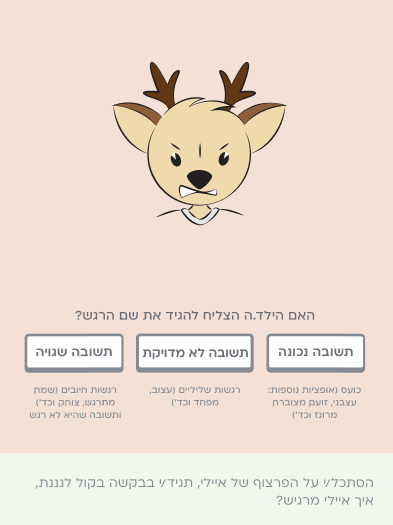
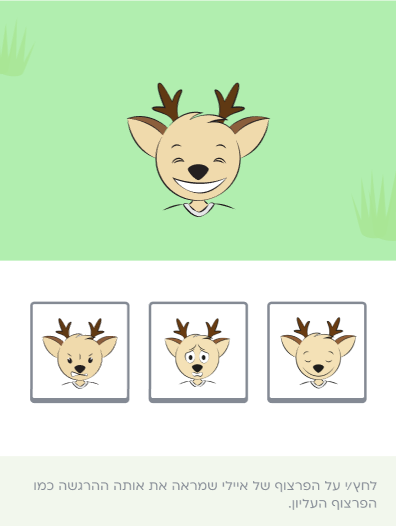
The child meets Eyali, a familiar and beloved character from the ICS program, and together they embark on an interactive journey that involves observing emotions, making age-appropriate choices, and opportunities to express oneself.
What Happens during Eyalchik?

The child opens the Eyalchick tool on a tablet and is invited to play a short, intuitive game that has age-appropriate illustrations and animation, as well as a soundtrack.

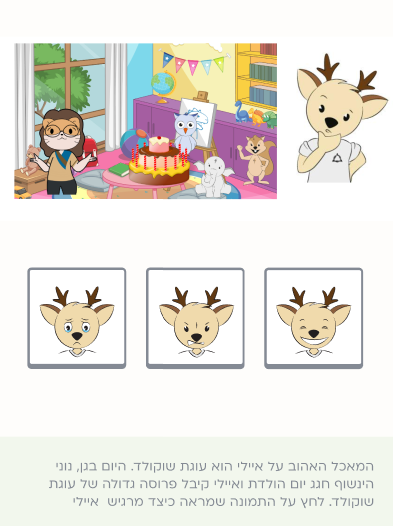
At each stage, the child is presented with situations from daily life and asked to using emotion recognition skills, among others, to choose a response from a few options.

Behind the scenes, every click and choice is coded according to a framework – so that the system knows how to generate insight regarding each child’s skills.

At the end, the teacher receives a culturally and developmentally sensitive report on the child's strengths and challenges plus suggestions for follow-up activities.
Want to Develop a Similar Tool?
Eyalchik is just the beginning. It was developed as part of the SEL.box project in partnership with the Yad Hanadiv foundation, Reichman University, and the University of Haifa. The project includes personality characterization, MVP construction, large-scale pilots, and scientific validation.
If you also believe that SEL in early childhood deserves a smart, experiential, and accurate tool, we would be happy to develop the next tool together with you.
Eyalchik – Research Summary
Eyalchik, a tool for assessing emotion recognition skills in early childhood, was developed in a systematic, multi-stage research and development process that was designed to address a real need that had been identified in the field: the lack of a suitable, reliable, and experiential tool to assess social emotional skills in early childhood. The process began with an in-depth persona study, during which information was collected directly from preschool staff about challenges, barriers, and needs in the assessment process. This laid the theoretical and practical foundation for defining the rest of the development process. The team then moved on to developing an interactive prototype that was based on performance tasks. This prototype combined relevant culturally and developmentally appropriate content with a character that children identified and loved. At this stage, performance tasks were built to assess social emotional skills in accordance with the latest conceptual framework; scoring and feedback protocols were defined to facilitate data-based assessment.
Three pilots were carried out during the development process:
- Pilot I – Mapping needs and initial reactions of the target audience.
- Pilot II – Testing usability and content on preschool teachers and children in a variety of preschools in order to identify areas to improve in the interface and instructions.
- Pilot III – Testing the initial validity of the performance tasks on 47 three-four-year-old children in various regions of Israel.
The findings indicated that the children found the tool highly engaging, were responsive to visual feedback, and understood the instructions well when they were short, clear, and provided visually. The preschool teachers found the tool had significant value as it was compatible with their daily work in the preschool. That said, the pilots also indicated a need to improve the instructions, simplify the interface, and add more options.
Summary of Main Research Findings
Task 1
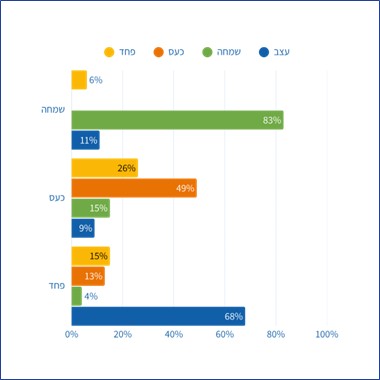
Identifying Happy Faces
The emotion of joy was identified most accurately, with a success rate of about 83%, indicating that preschool children recognize happy expressions relatively easily.
Task 2
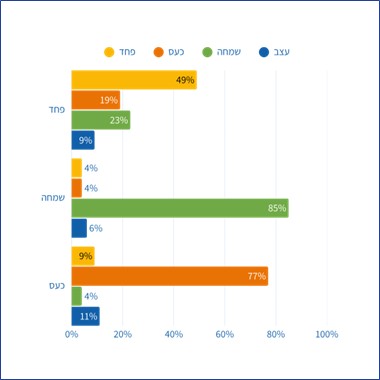
Matching Emotions to Names
The findings for this task indicated children possessed a relatively high understanding of the names of emotions, especially for conspicuous and positive emotions.
Task 3
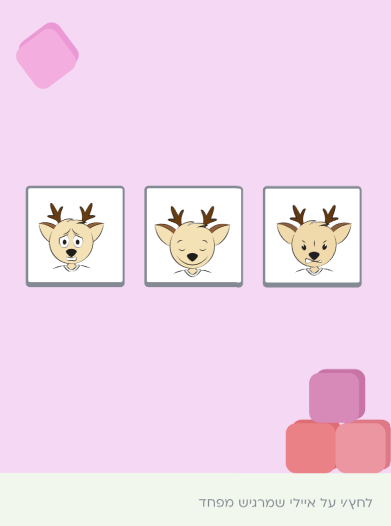
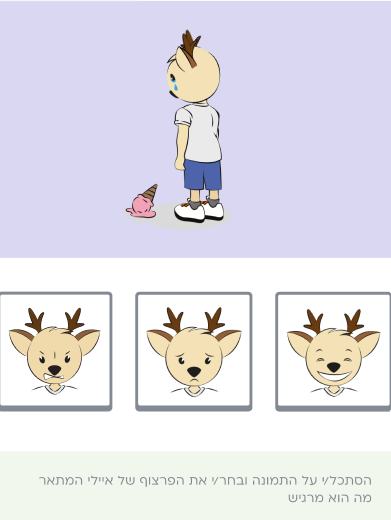
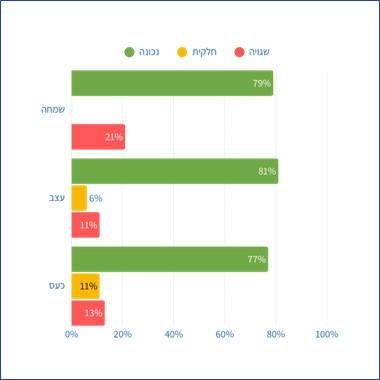
Matching Emotions to Situations
The findings for this task reinforce the conclusion that preschoolers identify positive emotions relatively accurately, while identifying negative emotions is more challenging.
Task 4
Naming Emotions
The findings show that children were able to identify basic emotions, but there are still gaps between identification and accurate verbal retrieval, especially when it comes to negative emotions.
Task 5
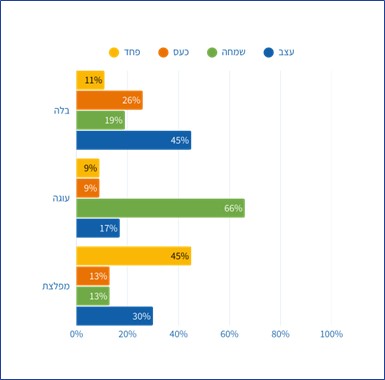
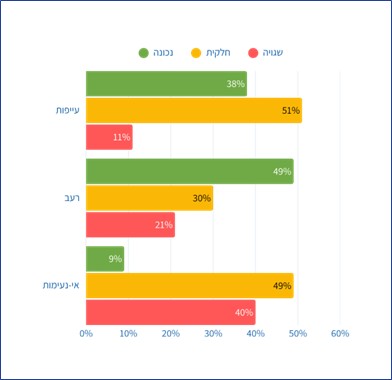
Identifying Sensations
The findings indicated differences in how successful children were at identifying different sensations. Children seemed to have difficulty identifying general, unfocused physical sensations.
Task 6
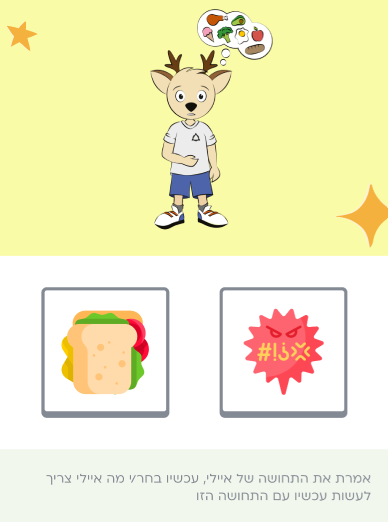
Responding to Sensations
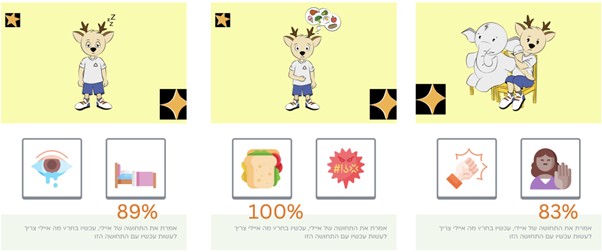
The findings showed a high level of accuracy in choosing an appropriate response. When presented with a sense of hunger, all children were able to choose the appropriate response – eating. When presented with a sense of tiredness, the accuracy rate also was very high and 89% of the children chose the action of resting or sleeping.
Task 7
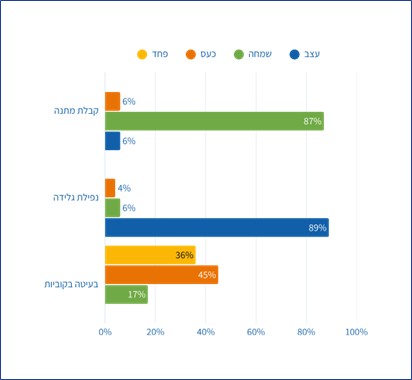
Matching Emotions to Behavior
The findings showed that when a behavior clearly and acceptably expresses a positive or negative emotion, the children were able to identify it accurately.
Who is Eyalchik for?
Municipal education departments, developers of early childhood interventions, research and evaluation professionals, and tool developers who want to collect high-quality data on SEL skills while providing young children with a fun, playful experience.
Want to Develop the Next Tool with Us?
We would be happy to cooperate with you to develop infrastructure for your needs.