

What is SEL?
Social-emotional learning (SEL) is a process through which the individual acquires and effectively uses knowledge, capabilities, attitudes, and skills necessary for dealing with day-to-day challenges and thus develop into inquisitive people who are able to understand their emotions and those of others. It also enables people to have positive interactions with others, act from intrinsic motivation, exhibit flexible thinking, and develop the abilities to persist, regulate emotions and behavior, and make responsible decisions.
In recent years, there has been a dramatic rise in both research and practice of SEL. In the past four years alone, over half a million SEL-related scientific articles have been published. This extensive pool of knowledge includes articles that emphasize a wide range of areas and a variety of definitions and points of view.
In the short film below, Dr. Daphne Koppelman-Rubin, the head of SEL.IL, presents the main points of consensus among SEL scholars and practitioners.
What are SEL Competencies?
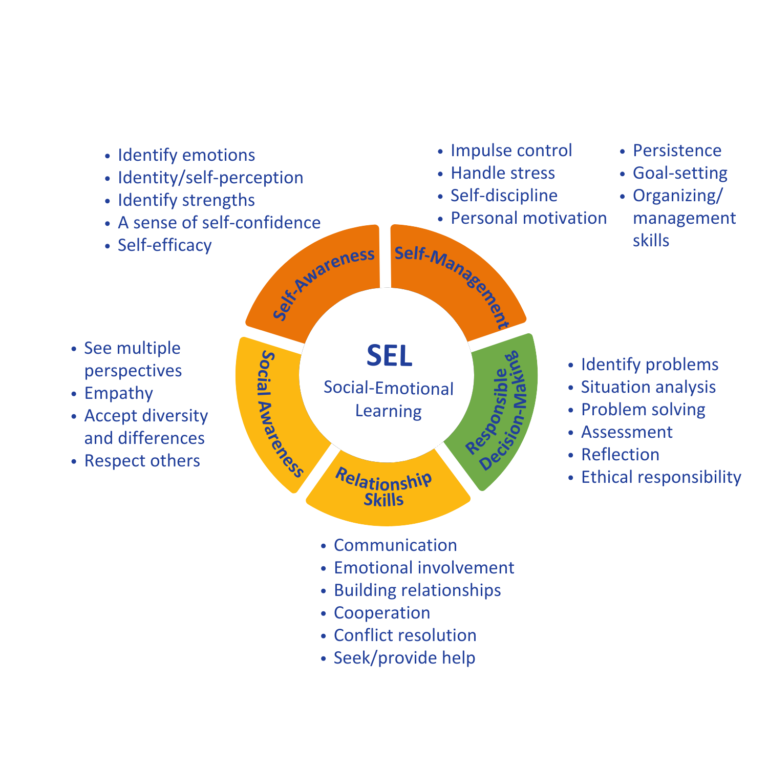
SEL competencies are the abilities to coordinate between cognitive, emotional, and behavioral processes that facilitate optimal development, achieving goals, and success in a variety of relationships and cultural environments. The CASEL model organizes these competencies into five main categories: intrapersonal skills, attitudes and abilities (self-awareness and self-managment); interpersonal skills, attitudes and abilities (social awareness and relationship skills); and responsible and ethical decision-making in personal and social situations (responsible decision making).
The ability to accurately identify my feelings, thoughts, and values and how they affect my behavior. The ability to accurately identify my strengths and weaknesses with a sense of security, optimism, and belief in the ability to develop and grow (growth mindset).
- Identify emotions
- Identity/self-perception
- Identify strengths
- A sense of self-confidence
- Self-efficacy
The ability to successfully regulate my emotions, thoughts, and behaviors in different situations – to deal effectively with stress, control impulses, and motivate myself. The ability to set personal and academic goals for myself and then work to achieve them.
- Impulse control
- Handle stress
- Self-discipline
- Personal motivation
- Persistence
- Goal-setting
- Organizing/management skills
The ability to take the other’s point of view and be empathetic towards it, including towards people from different backgrounds and cultures. The ability to understand social and ethical norms and see them as resources and a source of support.
- Ability to see from multiple perspectives
- Empathy
- Acceptance of diversity and differences
- Respect for others
The ability to create and maintain healthy and rewarding relationships with a variety of individuals and groups. The ability to communicate clearly, hear others, cooperate with others, resist negative peer pressure, manage conflicts effectively, and offer and seek help when needed.
- Communication
- Emotional involvement
- Building relationships
- Cooperation
- Conflict resolution
- Search for/provide help
The ability to make decisions about behaviors and social interactions based on ethical standards, social norms, and caring about and maintaining safety and security. The ability to realistically evaluate the results of various actions and their impact on one’s own well-being and the well-being of others.
- Identify problems
- Situation analysis
- Problem solving
- Assessment
- Reflection
- Ethical responsibility

Updated CASEL Conceptual Framework
The Collaborative for Academic, Social, and Emotional Learning (CASEL), the leading organization in the United States dedicated to advancing SEL, published an updated version of its conceptual framework in 2020. From the time it was first developed, this framework has provided guidance to numerous countries around the world. The updated framework emphasizes the importance of social-cultural sensitivities, the values of equality and fairness, and the significance of trust and cooperative, authentic relationships between families, educational systems, and communities. Such cooperation is meant to establish a learning experience and environment that includes trust, cooperative relationships, precise, meaningful academic programs, and continuous evaluation.
According to CASEL, SEL is an inseparable part of education and personal development. SEL contributes to both educational capital and excellence in the educational system. It also can help address a variety of issues related to inequality and encourage adults and children to work together to create thriving schools and develop secure, healthy, and equitable communities.
CASEL defines SEL as a process through which children and adults acquire and apply knowledge, skills, and attitudes in order to:
- Develop a healthy identity
- Manage emotions
- Achieve personal and collective goals
- Feel and display empathy
- Establish supportive relationships
- Make responsible and caring decisions
Why is SEL Important?
SEL competencies can serve as a significant source of resilience throughout life. In the long term, they are linked to academic success, professional success, and better emotional and physical health. The extensive research on SEL programs provides ample evidence that SEL contributes to student's academic, emotional, and social functioning.
On the Rise
- A rise in academic achievements
- An improved learning atmosphere
- A rise in students’ engagement in and enjoyment of their studies
- A rise in effectiveness of instruction
- A stronger student-teacher relationship
Fewer Problems
- Fewer behavioral problems
- Fewer signs of stress
- A decrease in symptoms of depression
- A decrease in anxiety
Educational Staff
- A rise in the sense of personal and professional efficacy
- A rise in personal wellbeing
- A decline in levels of distress
- A fall in burnout and leaving the profession
A Few More Facts about SEL
- The younger children are when SEL competencies are introduced as an integral part of their educational programs, the stronger the impact is.
- Acquiring SEL competencies benefits all children – not just children with learning difficulties or children at risk.
- Acquiring SEL competencies helps reduce social gaps. Children who come from less privileged backgrounds benefit the most from SEL programs.
- SEL programs are equally effective whether implemented by a psychologist/school counselor or a teacher.
Why Now?
Today’s world is experiencing dramatic social, cultural, and economic changes. It is becoming increasingly evident that young people must acquire SEL skills and abilities to help them successfully deal with the world’s complex realities and uncertainties (e.g., the corona crisis).
A constantly growing body of research indicates that optimal learning occurs in a safe environment where interpersonal relationships cultivate curiosity, asking questions, intrinsic motivation, a growth mindset, and the ability to persevere throughout difficulties and crises.
Trends in neuroscience research indicate that emotional-interpersonal processes and learning processes are integrated at both the level of brain function and behavior. Research shows that flexible thinking and the ability to change are possible throughout the entire lifecycle.
A continual increase in the percent of children and adults dealing with emotional distress, such as anxiety and depression, alongside a decline in the age when children begin showing signs of this distress has fostered the understanding that the best way to address this is via preventive measures in children’s natural setting, that is, in kindergartens and schools.